What does integrity look like today?
What does integrity look like today?
I asked this sometime in April of 2026, after a run of self-inflicted failures. Not the noble kind. The kind where you look back and can point at the exact moment you began working against yourself. The question that came out of it was short and unpleasant: do I have integrity, or don’t I?
We use the word constantly, always as praise. Nobody stops to check what they’re praising.
So I asked Claude. It said integrity comes from integer, which means undivided. Whole. Complete. And another thousand words after that. I sat with it for a while and realized it had given me more words and fewer answers. So I said to myself: why not go on a self-drive.
Here are the valleys we visited.
The better deal
Ten years ago I had just moved out. First place of my own. I made a deal with one of my father’s friends to provide me with furniture.
A handshake. No paper.
Then I found a better deal somewhere else.
I had just been introduced to Adam Smith. We all live in a marketplace, I told myself. Adam gave me all the courage I needed to walk out of the handshake and take the better number. I patted myself on the back. We did good, Shiv.
My father’s friend was angry. Fair enough. But here is the part I couldn’t explain at the time: why was I feeling like shit? The whole plan was to make myself happier, and I ended up making my position worse. Somehow I optimized and lost.
I ended up finding another buyer for his furniture. I had to transfer the whole thing over — that seemed like my way of rectifying it. I rolled my head and said, look, they can’t take a loss.
That is not supposed to happen. If the model is right, more surplus is more surplus.
So who was wrong — Adam or me?
It took a couple of semesters of micro to answer that, and the answer is neither. Smith never said promises are free to break. He wrote The Theory of Moral Sentiments seventeen years before The Wealth of Nations, and the invisible hand sits on top of it, not beside it. Markets clear because the people inside them can be relied on. Take that out and you don’t get a more efficient market. You get no market — just a long series of expensive one-shot games with strangers.
What I actually did was price the furniture correctly and price my utility function wrong. The utility from that deal should have carried a term for walking out on my father’s friend, a man who, in his own mind, was helping.
My father called me and said something about integrity. I was newly out of the house and knew more than him, so I filed it under lecture and moved on.
I never knew why I kept going back to that moment.
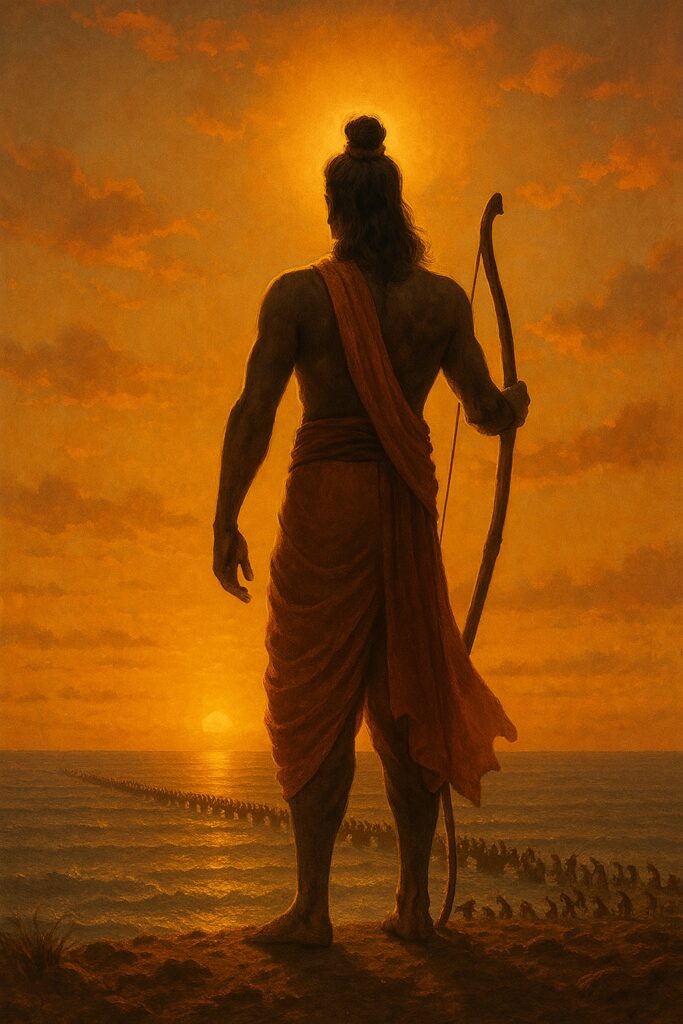
Raghupati Raghav Raja Ram, Patit Pavan Sita Ram
Some years later, I asked myself a life-changing question. Why do we say Ram is the highest expression of a human being? What made him so special? And why him?
Tulsidas answered it in five words. Jaan jaye par vachan na jaye. Let the life go, but not the word given.
A prince stripped of his throne. A husband who has lost his wife. At the worst hours of his life, the promises held. And they weren’t held with grudges, not with the face of a man paying off a debt. They were held with Grace.
That is the part I keep returning to. Anyone can keep a promise resentfully. Keeping it with a straight back and no bitterness is a different order of things.
What it does’nt mean?
Here is where I have to be careful, because the obvious reading is wrong.
The obvious reading is: whatever you said in the past, you are stuck with it. Integrity as a decision made in the past for your future self.
That can’t be right. That version is a sword anyone can pick up and use on you. Get a promise out of a man in a weaker hour, then hold him to it forever in the name of his own honour. People do this. It works.
And Ram doesn’t fit that reading either. The exile was not his promise. It was his father’s promise, made in a time of glory. Ram did not revolt. He did not gather armies and tell his father he was being impractical. He did not argue it out with anyone. He knew the way of the Raghus, his forefathers: jaan jaye par vachan na jaye. He followed the dharma of a son, of a Raghuvanshi.
So integrity is not the past governing the future. It is alignment with swa dharma. Your own guiding principles. Being whole within your own way of life.
Take a man who doesn’t drink. He is not being held by a vow he made years ago. He re-decides at every corner — every dinner, every wedding, every bad night — and still lands in the same place each time. The decision is not a cage. He is free of it precisely because it is settled. He doesn’t have to relitigate himself at every table.
So, a working definition: integrity is knowing where your boundaries are and standing in them. As if this is what the cosmos sent you for.
By that test, the furniture deal fails.
Not because a handshake is legally binding. Because I went back on my word the moment I got myself a better deal – and somehow still ended up worse off.
Today’s age?
What changed in our age is not that enforcement disappeared. Enforcement is everywhere. Contracts, compliance, HR, reviews, ratings, your name sitting permanently in a search bar.
What changed is that enforcement went impersonal. It moved out of relationships and into institutions. Which means a handshake with a friend of the family — no paper, nothing behind it — is now one of the last places left where nothing holds you but you.
Anything with a signature on it will be enforced. Everything without one is now purely a question of what you are.
That is a strange kind of freedom. Most of our behaviour now is self-driven and unwatched. We can run on appetite — eat, sleep, fuck — and there is a good chance nothing outside us ever corrects it. That option is fully available. It is the animal one. No integrity.
Or we carry ourselves with Grace.
Nobody is coming to enforce it. That is the whole point. That is why it counts.
So – what is integrity in today’s age?
It is not compliance. Compliance is someone else’s rule. I would rather be a renegade.
And definitely not reputation. That is just validation from others.
Integrity is being whole with your dharma — your way of life — and that is what tells you where your boundaries are. Delivering on promises and responsibilities without worrying about what it will cost, because losing integrity is the bigger loss. And most importantly, doing it with Grace.
Because that is the way of Ram.
Jai Shri Ram.